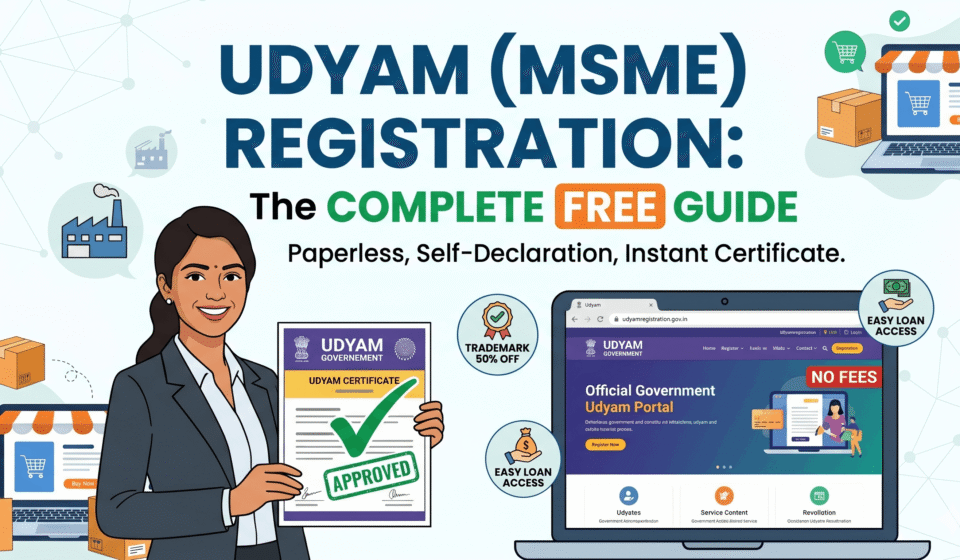
Udyam (MSME) Registration — The Complete Free Step-by-Step Guide (2026)

Of all the registrations a new business in India needs, Udyam Registration is the one with the best ratio of effort to reward. It costs nothing, takes well under thirty minutes once you have your details ready, requires zero document uploads, and unlocks a genuinely useful set of benefits — from a 50% discount on trademark fees to collateral-free loans up to ₹10 crore.
And yet it remains one of the most under-utilized registrations among small businesses and first-time ecommerce sellers — partly because people assume “government registration” automatically means paperwork and fees, and partly because the internet is full of paid portals deliberately designed to look official.
This guide covers everything: why Udyam is free, the 2025 classification overhaul that changed who qualifies, exactly what details you need, the complete step-by-step registration process, how to avoid scam websites, and the full list of benefits — explained in plain language.
What Is Udyam Registration, Exactly?
Udyam Registration is the official government system — run by the Ministry of Micro, Small & Medium Enterprises (MSME) — for formally recognizing a business as a Micro, Small, or Medium Enterprise. It replaced the older Udyog Aadhaar Memorandum (UAM) system, and registration gets you a unique Udyam Registration Number (URN) along with a digitally signed e-certificate carrying a verifiable QR code.
Importantly, Udyam Registration isn’t mandatory by statute to simply run a business — but it is the only mechanism that lets you formally claim MSME-specific benefits: priority sector lending, collateral-free credit guarantees, delayed payment protection, government tender preferences, and more. Without it, you’re treated as a non-MSME entity by banks, government departments, and most institutional buyers, even if your business genuinely qualifies by size.
Who can register: any proprietorship, partnership firm, LLP, private limited company, co-operative, or registered society engaged in manufacturing, trading, or services — including online sellers on Amazon, Flipkart, Meesho, or their own website — provided the business falls within the prescribed investment and turnover limits.
Why Is Udyam Registration 100% Free?
A common assumption among new entrepreneurs is that any government registration involves processing fees. Udyam is a deliberate exception — the Ministry of MSME made it completely free to register, with no government charge to process your application or issue your digital certificate.
The reasoning is straightforward: the government wants to formalize as much of India’s small business economy as possible, improve “Ease of Doing Business” rankings, and ensure micro-entrepreneurs can access formal credit without financial barriers at the very first step. Charging a fee for the registration that’s supposed to unlock financial inclusion would work against the entire point of the scheme.
Beware of Fake Portals: How Paid Scam Websites Operate
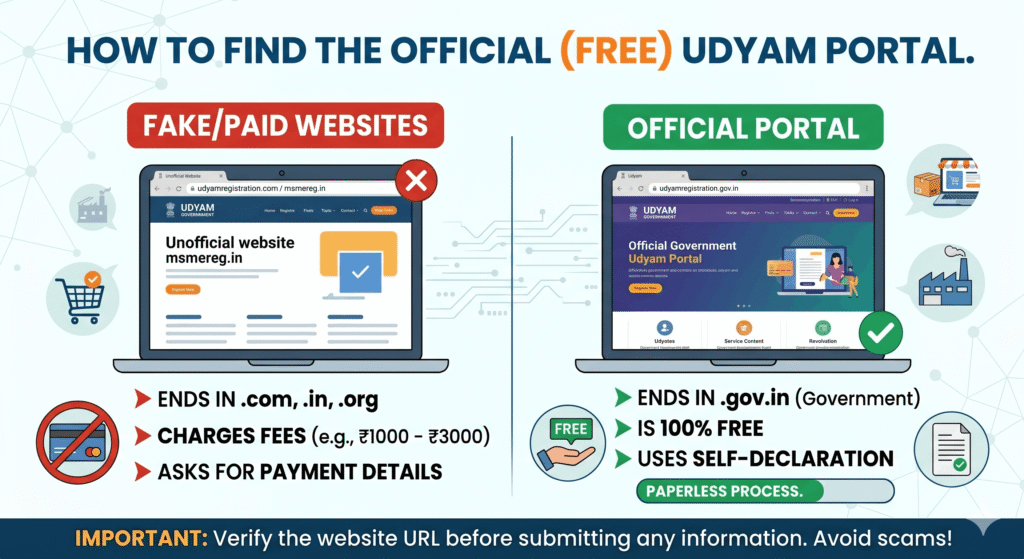
Because Udyam is so widely searched, the internet is full of private portals and “consultants” charging anywhere from ₹1,000 to ₹3,000 (sometimes more) for a service that costs nothing. Many of these sites are built to closely mimic the look of the real government portal.
How to verify you’re on the genuine site:
- Check the exact domain. The only official portal authorized to issue Udyam certificates is udyamregistration.gov.in. Any site ending in
.com,.org,.co,.in(other than the official.gov.in), or.ltdclaiming to be the “Udyam portal” is an unofficial third party — not necessarily illegal, but not the government, and not free. - No payment gateway should ever appear. The genuine portal has no checkout page and never asks for card details, net banking, or UPI payment to process your registration. The moment a “Pay Now” button appears during what should be a free government application, close the tab.
- Be skeptical of urgency tactics. Countdown timers, “limited time offer ₹500 off,” or “47 registrations completed today” banners are marketing tactics used by paid consultancy sites — the actual government portal has none of this.
Worth knowing: Some legitimate CA firms and consultancies do offer paid Udyam registration assistance — helping you pick the correct NIC code, checking your classification, and handling the process end-to-end for a fee. That’s a legitimate service choice if you want hand-holding. The issue is only with sites that pretend to be the government portal itself while charging for what is officially free.
The 2025 Classification Overhaul: What Changed and Why It Matters
This is the single most important update for anyone registering in 2026 — the MSME classification thresholds were significantly revised, and getting this right affects which category your business falls into and which benefits you can access.
The Old vs New Limits
Through Notification S.O. 1364(E), dated March 21, 2025, the Ministry of MSME revised the classification criteria effective April 1, 2025 — investment limits were raised 2.5x and turnover limits were doubled across every category:
| Category | Investment Limit (Plant & Machinery/Equipment) | Turnover Limit |
|---|---|---|
| Micro | Up to ₹2.5 crore | Up to ₹10 crore |
| Small | Up to ₹25 crore | Up to ₹100 crore |
| Medium | Up to ₹125 crore | Up to ₹500 crore |
For comparison, the previous limits (effective until March 31, 2025) were ₹1 crore/₹5 crore (Micro), ₹10 crore/₹50 crore (Small), and ₹50 crore/₹250 crore (Medium) — so this is a meaningful jump, not a minor adjustment.
It’s Still a Composite Test — Both Numbers Matter
A common point of confusion: classification is based on both investment and turnover together — not turnover alone. To qualify for a given category, your business must stay within both limits simultaneously.
- If you exceed the ceiling in either investment or turnover, you move up to the next higher category.
- You only move down to a lower category if you fall below the ceiling in both criteria.
Worked example: if your business has ₹1.5 crore in investment (within the Micro limit) but ₹15 crore in turnover (above the Micro limit of ₹10 crore), you’d be classified as Small — because turnover alone pushed you past the Micro threshold, even though your investment was still well within range.
A Few Calculation Details Worth Knowing
- Investment counts the cost of plant and machinery (manufacturing) or equipment (services) — land, buildings, and pollution-control equipment are excluded from this calculation.
- Turnover is your annual sales figure straight from your GSTR or income tax return — but export turnover is excluded from the count. A strong export year won’t accidentally push you into a higher category.
- PAN-level aggregation: all GSTINs registered against the same PAN are treated as one single enterprise for classification purposes — investment and turnover are aggregated across all of them, not assessed separately per GSTIN.
What This Means If You’re a Growing Ecommerce Seller
The bigger limits give you considerably more breathing room to scale before “graduating” to a higher MSME category and potentially losing access to certain micro/small-specific benefits. A business that would have been forced into the “Small” category under the old rules might now comfortably remain “Micro” — which matters, since some schemes and incentives are tiered specifically toward smaller categories.
The Paperless Advantage: How Self-Declaration Actually Works
Older government registrations typically meant scanning physical documents, attaching balance sheets, and uploading PDFs. Udyam works differently — it’s built entirely on a paperless, self-declaration model.
How the backend actually verifies you without documents:
- The portal is directly integrated with the Income Tax Department and GST Network (GSTN) databases via API.
- Once you authenticate your PAN, the system automatically pulls your investment and turnover figures from your most recent Income Tax Returns (ITR) and GST filings — you don’t manually enter or upload balance sheets, sales invoices, or financial statements.
- If you don’t have a GSTIN yet (you’re below the GST threshold or haven’t registered), you can still register for Udyam using just PAN and Aadhaar — in that case, turnover and investment are self-declared rather than auto-fetched, and verified later through your ITR.
This integration is also why accuracy in your tax filings matters more than people realize — if your GSTR-3B or ITR has errors, those errors flow directly into your Udyam classification. Filing corrected returns is the fix; the Udyam portal will auto-sync with the corrected data afterward.
What Details You Need Before You Start
You won’t upload any files, but you do need these exact details on hand:
| Requirement | Details |
|---|---|
| Aadhaar Card | Mandatory for the proprietor, managing partner, or authorized director. Must have an active mobile number linked for OTP verification |
| PAN Card | Your personal PAN (proprietorship) or the business PAN (LLP/Pvt Ltd/Society), along with the authorized signatory’s personal PAN for corporate entities |
| GSTIN | Required if your business is GST-registered or liable for GST. If you’re not GST-registered yet, you can still proceed using PAN and Aadhaar alone |
| Bank Account Details | Account number and IFSC code for your current business account (or active savings account) — critical for receiving any scheme-linked subsidies |
| NIC Activity Codes | The National Industrial Classification codes that describe your actual business activity (manufacturing, trading, or services) |
Step-by-Step: How to Register for Udyam Online
The entire process typically takes under 30 minutes if your details are ready. Here’s the exact sequence:
Step 1: Go to the Official Portal
Navigate directly to udyamregistration.gov.in. Don’t search and click the first result blindly — type the URL directly or verify it carefully, given how common look-alike portals are.
Step 2: Choose the Right Registration Path
- Click “For New Entrepreneurs who are not Registered yet as MSME” if this is your first registration
- If you previously held a Udyog Aadhaar Memorandum (UAM), click “For those already having registration as UAM” to migrate instead — by 2026, banks, government tender portals, and most MSME payment-protection systems have stopped accepting old UAM documents entirely, so migrating is no longer optional if you want continued access to benefits
Step 3: Complete Aadhaar Authentication
Enter the authorized signatory’s full name exactly as it appears on Aadhaar, along with the Aadhaar number. Click “Validate & Generate OTP”, retrieve the OTP sent to your Aadhaar-linked mobile, and enter it to verify.
Step 4: Validate PAN Details
Select your Type of Organization (Proprietorship, Partnership Firm, LLP, Private Limited Company, etc.) and enter your PAN. The portal validates this instantly against government records and — where applicable — auto-fetches your past turnover and investment data from your ITR and GST filings.
Step 5: Enter Business Details
Fill in your formal enterprise name, registered business address, date of commencement of business, active email ID, and bank account details (account number + IFSC).
Step 6: Select NIC Activity Codes
This step deserves extra care — it’s also the single most common mistake applicants make. Search the portal’s built-in NIC code database and select codes that accurately describe what your business actually does, across manufacturing, trading, or services as applicable. You can add multiple activities under one registration if your business genuinely spans more than one category.
Why this matters more than it seems: declaring the wrong or overly generic NIC code can force a reclassification later and can delay MSEFC (delayed-payment) complaints by 30 to 60 days if a dispute arises. Take the extra few minutes to search properly rather than picking the first vaguely-related result.
Step 7: Declare Turnover and Employee Details
Enter your total annual turnover for the relevant previous financial year, along with your employee count. Where GST/ITR integration applies, much of this auto-populates — but you should still verify the figures rather than assuming they’re correct, since errors compound into your classification.
Common mistake to avoid: don’t accidentally include export turnover in this figure — exports are excluded from the MSME turnover calculation, and including them can push you into a higher category than you actually qualify for.
Step 8: Final Review and Submission
Review every section carefully. Click “Submit and Get Final OTP”, enter the OTP, and the system will auto-classify your enterprise as Micro, Small, or Medium based on the declared data, cross-verified against your ITR and GST records.
Step 9: Receive Your URN and Certificate
The system generates a unique Udyam Registration Number (URN) instantly on-screen, with confirmation sent to your registered email. Your formal e-certificate — featuring a verifiable QR code — is typically ready to download within 2 to 4 days, though many applications now complete this near-instantly.
Five Mistakes That Cause the Most Problems Later
These aren’t hypothetical — they’re the recurring issues that create real friction with banks, schemes, and delayed-payment claims down the line:
1. Choosing the wrong or overly generic NIC code. This is the single most common error. A mismatched code forces reclassification and can delay MSEFC complaints by 30–60 days when you actually need them.
2. Including export turnover in your declared figure. Export revenue is specifically excluded from MSME turnover calculations — including it inflates your numbers and can push you into a higher category unnecessarily.
3. Registering under an individual’s name when the actual business is a partnership or company. This creates a mismatch against the PAN database and can cause downstream verification issues.
4. Treating Udyam as a one-time filing. It isn’t. More on this below.
5. Letting an old Udyog Aadhaar Memorandum sit unmigrated. UAM credentials are increasingly rejected by banks and government portals — if you still hold one, migrate to Udyam now rather than waiting until a bank or tender process forces the issue.
Udyam Is Not “Set and Forget” — Annual Updates Matter
A genuinely important 2026 reality that many founders miss: your Udyam certificate has lifetime validity with no renewal fee, but it is not fully static. You’re expected to update your turnover, investment, and other details after every financial year so your classification stays accurate.
How this works in practice:
- Financial data (turnover and investment) is largely auto-updated from your GSTR and ITR filings — if your returns are filed correctly and on time, the system recalculates your classification automatically, typically within 24–48 hours of the data becoming available.
- If your returns aren’t filed, or contain errors, the data won’t update correctly — which is yet another reason GST and income tax compliance (covered in our other guides) directly affects your MSME standing.
- Certain details must be updated manually — business name changes, address changes, NIC code modifications, and bank account changes don’t auto-sync and need to be edited directly on the portal, generally within 30 days of the change occurring.
If you cross a threshold and move to a higher category — say, from Micro to Small — this isn’t a penalty. It’s simply growth being reflected accurately. Some category-specific scheme benefits may shift, but existing loans, benefits, and your overall MSME status continue; only new applications going forward are assessed under the updated category.
Unlocking the Benefits: What Udyam Registration Actually Gets You
This is where the small time investment pays off disproportionately. Here’s the full picture:
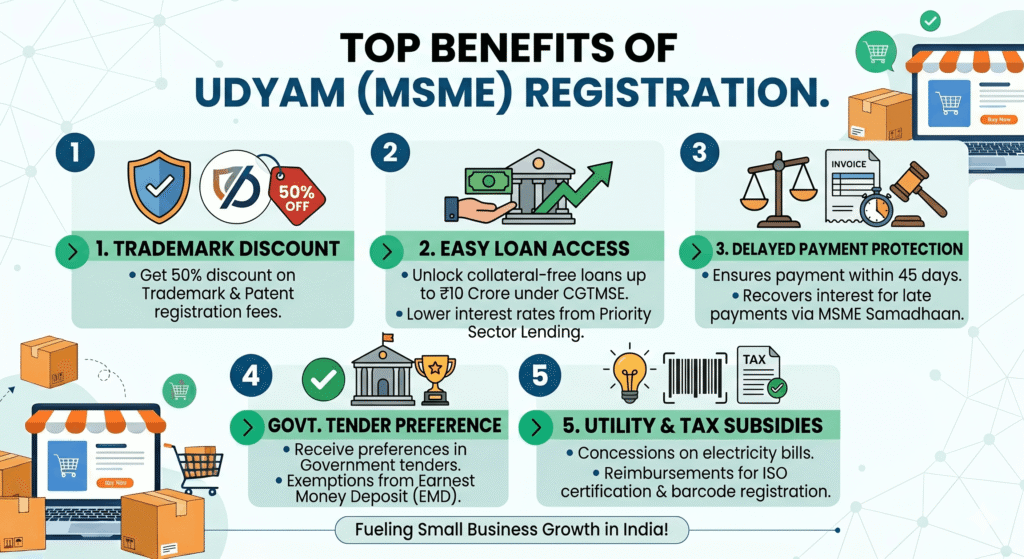
50% Discount on Trademark Registration
MSME-registered businesses get a flat 50% reduction on government trademark filing fees — a meaningful saving if you’re protecting a brand name and logo as a new seller. (Our complete trademark registration guide walks through the filing process in detail.)
Collateral-Free Business Loans
Under the Credit Guarantee Fund Trust for Micro and Small Enterprises (CGTMSE) scheme, registered MSMEs can access collateral-free institutional loans — coverage was increased from ₹5 crore to ₹10 crore for micro and small enterprises in the Union Budget 2026-27. Banks are also required to meet Priority Sector Lending targets for MSMEs, which in practice tends to mean faster approvals and interest rates roughly 1–2% lower than standard commercial borrowing.
Protection Against Delayed Payments
Under the MSME Delayed Payment provisions, buyers are legally required to settle accepted invoices to a registered MSME within 45 days. If they don’t, they become liable to pay compound interest at three times the prevailing bank rate. Disputes can be filed directly through the MSME Samadhaan portal, with automatic Udyam status verification for eligibility.
There’s a tax-side enforcement mechanism backing this too: larger businesses can only claim a tax deduction for payments to MSME suppliers in the same financial year if the payment is made within 45 days. Cross that window, and the deduction shifts to whichever year the payment actually clears — under Section 43B(h) of the Income Tax Act, which gives buyers a direct financial incentive to pay MSME suppliers on time, not just a compliance obligation.
Government Tender Preferences and Procurement Reservation
Udyam-registered businesses get preference in government tender evaluations and are exempt from paying Earnest Money Deposits (EMD) when bidding. There’s also a 25% government procurement reservation specifically carved out for MSMEs.
Additional Schemes (2026 Updates)
The Union Budget 2026-27 added a few newer benefits worth knowing about:
- Export Support: term loan guarantee cover up to ₹20 crore for export-focused MSMEs
- TReDS Mandate: central public sector enterprises are now required to use the Trade Receivables Discounting System when procuring from MSMEs — letting you discount unpaid invoices for faster cash flow
- SME Growth Fund: a ₹10,000 crore fund announced to provide equity support to high-potential MSMEs
- Micro Enterprise Credit Card: a ₹5 lakh credit facility specifically for micro-enterprises registered on Udyam
Utility and Compliance Benefits
Registered MSMEs also get concessions on industrial electricity tariffs, reimbursement support for GS1 barcode registration, subsidies on ISO quality certification costs, and — for eligible smaller enterprises — exemption from certain income tax audit requirements.
Udyog Aadhaar vs Udyam — If You’re Still on the Old System
If you registered years ago under the older Udyog Aadhaar Memorandum (UAM) system, you need to migrate. UAM has been formally phased out, and by 2026 most banks, government tender portals, and MSME payment-protection systems no longer recognize it. Holding only a UAM certificate increasingly means being treated as effectively unregistered for the purposes of new schemes and credit applications.
Migration is done through the same official portal, using the “For those already having registration as UAM” path — it follows largely the same Aadhaar/PAN verification flow as a fresh registration.
The Bottom Line
Udyam Registration is, relative to effort required, probably the single best-value compliance step available to any small business or new ecommerce seller in India. It costs nothing, takes well under half an hour with your details ready, and the downstream benefits — trademark discounts, collateral-free credit access, legal protection against late payments, and tender preferences — compound in value as your business grows.
The sequence to follow if you’re just starting out:
- Decide your business structure (read our guide)
- Register for GST if you’re selling on any marketplace (read our complete GST guide)
- Register for Udyam — free, takes minutes (this article)
- File your trademark application and claim your 50% MSME discount (read our trademark guide)
Once Udyam is done, you’ve unlocked one of the highest-leverage, lowest-cost moves available to a new business — and the rest of your documentation foundation is essentially complete.
Next step: With GST and Udyam both registered, your brand name and logo are valuable assets worth protecting early. Read our guide: Trademark Registration in India — Process, Cost, and Timeline Explained.
About This Article
This article is for general informational purposes and reflects the Udyam Registration framework and MSME classification criteria in India, including Notification S.O. 1364(E) effective April 1, 2025, as understood in early 2026. Classification thresholds, scheme benefits, and portal processes are subject to change by the Ministry of MSME and through subsequent Union Budget announcements. Always verify current details on the official portal (udyamregistration.gov.in) and consult a qualified Chartered Accountant (CA) for advice specific to your situation.