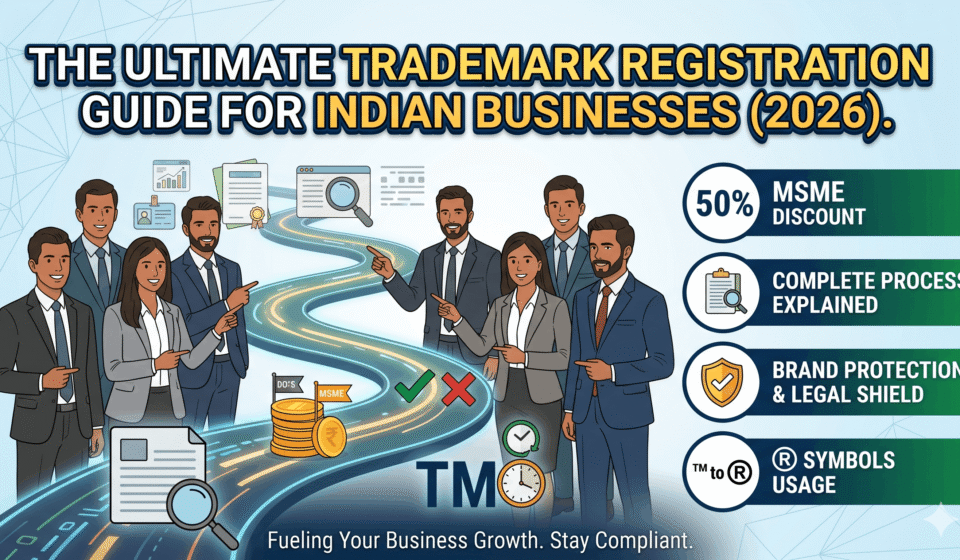
Trademark Registration in India — Complete Process, Cost & Timeline Guide (2026)

Your brand name, logo, and tagline are among the most valuable assets your business will ever own. Everything you invest in marketing, packaging, and customer trust builds equity in these identifiers. Without trademark registration, that equity has no legal protection — and anyone can start using a confusingly similar name in your product category, forcing you into an expensive rebrand or legal battle after you’ve already invested heavily in building recognition.
Trademark registration in India is the legal mechanism that changes this. Once registered, you hold exclusive rights to your mark nationwide, can put the ® symbol next to your brand name, and have statutory grounds to take legal action against infringers — without needing to prove prior use each time.
The good news in 2026: the process is faster and more accessible than it’s ever been. Filing to examination now takes 1–3 months, and the total timeline for an uncontested application runs approximately 8 to 12 months. For MSMEs and startups, the government fee starts at just ₹4,500 per class — and if you’ve already registered for Udyam, you already qualify for the 50% discount.
This guide covers everything: what can be trademarked, how the fee structure works, the step-by-step filing process, what to do if you get an objection or opposition, timeline expectations, and the most common — and most avoidable — mistakes.
What Is a Trademark — and What Exactly Can You Protect?
A trademark is any mark capable of distinguishing your goods or services from those of competitors. Under the Trade Marks Act, 1999, what can be registered is broader than most people realize:
- Word marks — your brand name or product name as text (e.g., “Medkon”, “Swachh Tea”)
- Device marks — logos and graphic designs
- Combined marks — word and logo together as a single unit
- Slogans and taglines — distinctive phrases associated with your brand
- Trade dress — distinctive packaging shapes or presentation styles
- Colour combinations — if sufficiently distinctive and tied to your brand
- Sound marks — recognizable audio signatures
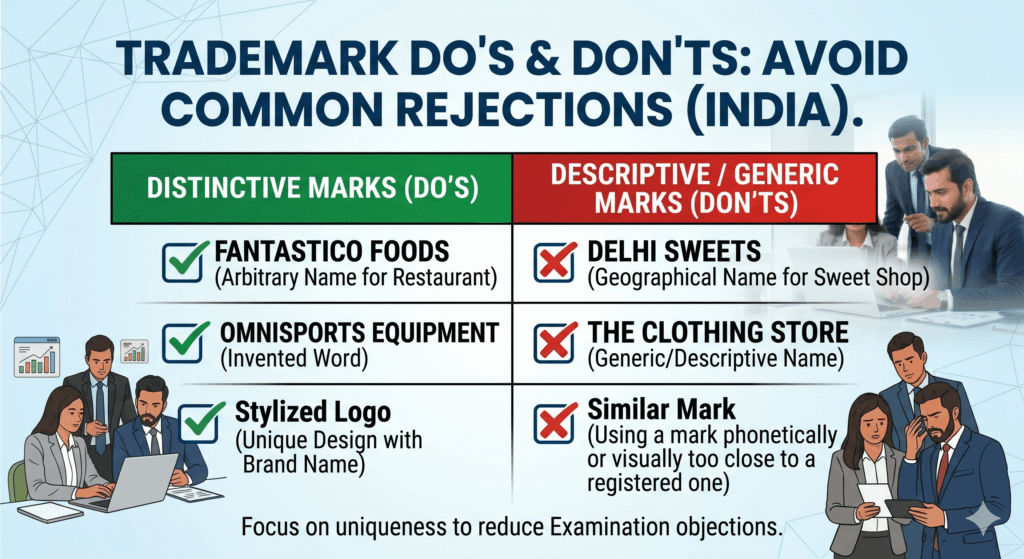
The critical principle: uniqueness matters. Generic or purely descriptive names get rejected. A mark that directly describes what the product is (“Fresh Juice” for a juice brand) or uses common dictionary words broadly has far more hurdles to clear than an invented, distinctive name. Unique and invented names get faster approval than generic ones.
TM vs ® — What You Can Use and When
This is one of the most commonly misunderstood distinctions:
- ™ (TM symbol): You can use this the moment you file your application — no waiting required. It signals that you are claiming trademark rights in this mark, even before the Registry has registered it.
- ® (Registered mark): This can only be used after your application has been formally approved and the registration certificate has been issued. Using ® before official registration is a legal offense under the Trade Marks Act.
Who Can Apply — Every Business Structure is Eligible
Any person who claims to be the owner of a trademark may apply for its registration — including individuals, sole proprietors, partnership firms, LLPs, private limited companies, public limited companies, trusts, societies, HUFs, and foreign entities. The applicant named in Form TM-A becomes the registered proprietor on successful registration.
For sole proprietors: you can register in your personal name alongside a trading name (e.g., “Irshad Khan trading as Medkon”). Your PAN, Aadhaar, and GST certificate (if registered) are the required identity documents.
Is Trademark Registration Mandatory?
No — registration is voluntary, not mandatory. However, an unregistered mark can only be protected through the common law remedy of “passing off”, which requires you to independently prove prior use and established goodwill through evidence every time someone copies you. That’s an uphill legal battle.
A registered trademark provides prima facie evidence of ownership and allows you to initiate infringement proceedings without proving prior use each time. The legal position is significantly stronger, and the deterrent effect on would-be copycats is real — a ® next to a brand name signals active legal protection in a way that ™ alone does not.
The Fee Structure — Exactly What You’ll Pay in 2026
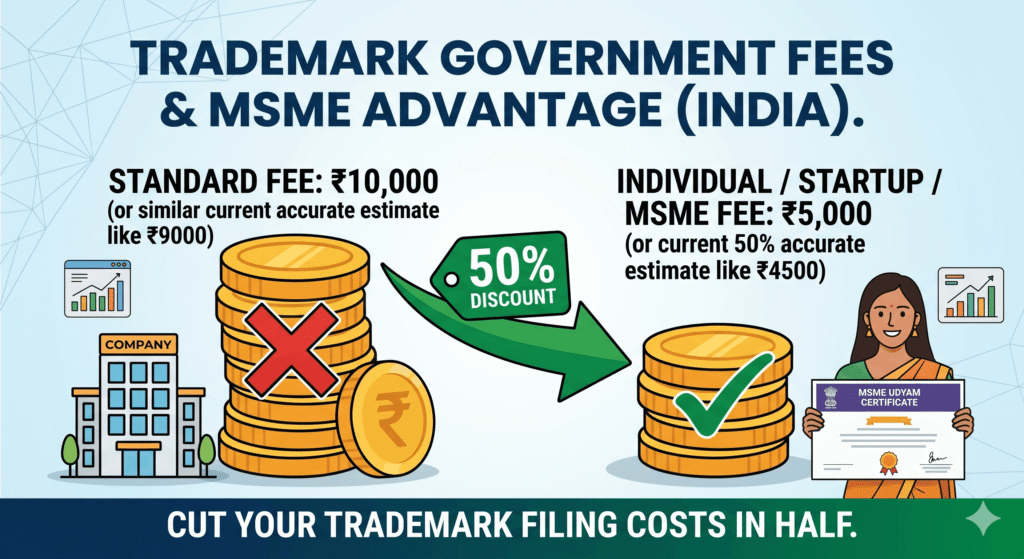
Government filing fees start at ₹4,500 per class for individuals, startups, and MSMEs filing online, and ₹9,000 per class for companies and LLPs. These are statutory government fees prescribed under the First Schedule of the Trade Marks Rules, 2017.
| Applicant Type | Online Filing (per class) | Physical Filing (per class) |
|---|---|---|
| Individual / Sole Proprietor | ₹4,500 | ₹5,000 |
| DPIIT-recognised Startup | ₹4,500 | ₹5,000 |
| MSME (Udyam-registered) | ₹4,500 | ₹5,000 |
| Company (Pvt Ltd / LLP / Others) | ₹9,000 | ₹10,000 |
Key points:
- Fees are per class per application — filing in three classes costs three times the per-class rate.
- Reply to examination reports and attending hearings attract no additional government fee.
- Renewal costs ₹9,000 per class every ten years. Miss the deadline and a surcharge applies; removal from the register requires a restoration fee of ₹18,000 per class.
- All fees are non-refundable once paid to the Registry — an incorrectly filed application means forfeited statutory fees with no recourse.
The MSME 50% Discount — How to Claim It
For MSMEs as defined under the MSMED Act, the Trade Marks Rules, 2017 provide a 50% concession in government fees, equating to the same fee slab applicable to individual applicants. This concession applies to all statutory charges payable to the Registry.
To claim the discount, you must submit your Udyam Registration Certificate (from udyamregistration.gov.in) at the time of filing. If your enterprise qualifies as an MSME but files without providing the certificate, the Registry processes the application at the higher ₹9,000 rate. There is no retroactive adjustment.
This is the single most important reason to complete your Udyam Registration before filing a trademark — it literally halves the government fee. (Our complete Udyam Registration guide walks through the free registration process.)
Professional/Attorney Fees
Government fees are only part of the picture. Professional fees for a trademark agent or attorney range from ₹2,000 to ₹10,000 per class in addition to government fees, depending on the complexity of the filing and whether it includes search, objection handling, and hearing support. Filing independently through the IP India portal is legally permitted but requires careful attention to class selection, search thoroughness, and documentation.
Expedited Examination — Paying to Skip the Queue
If your timeline is urgent, there is an official route to speed up examination: by filing Form TM-M and paying an additional prioritization fee of ₹20,000 for startups and MSMEs (₹40,000 for other entities), you can get your application examined within just one month instead of the standard queue. This can reduce your total timeline from 12–24 months down to just 6–8 months, assuming no opposition is filed.
Important caveat: the expedited route doesn’t bypass the mandatory four-month opposition window, so that period is non-negotiable regardless. And practitioners note that expedited applications aren’t always prioritized for hearings if objections arise — so if you receive an examination report with issues, the speed advantage may narrow.
Understanding Nice Classification — Choosing Your Classes Correctly
India follows the Nice Classification System, which divides all possible goods and services into 45 classes — Classes 1–34 cover physical goods, Classes 35–45 cover services.
Why this matters deeply: a trademark is only protected in the class or classes you file in. Trademark protection is class-specific — selecting the wrong classes leaves your brand exposed in the categories where you actually operate.
Classes Most Relevant for Ecommerce & D2C Brands
| Class | Covers |
|---|---|
| Class 3 | Cosmetics, skincare, hair care, personal care products, perfumes |
| Class 5 | Pharmaceuticals, dietary supplements, health products |
| Class 14 | Jewellery, watches, precious metals |
| Class 16 | Paper, stationery, packaging materials, printed matter |
| Class 25 | Clothing, footwear, headwear, apparel |
| Class 29 | Meat, fish, poultry, dairy products, processed vegetables |
| Class 30 | Coffee, tea, cereals, confectionery, baked goods, spices |
| Class 31 | Fresh fruits and vegetables, seeds, natural plants |
| Class 32 | Beers, mineral waters, juices and other non-alcoholic beverages |
| Class 35 | Retail services, online retail, business management, advertising |
| Class 42 | Technology and software services, IT, SaaS |
| Class 43 | Food and beverage services, restaurants, cafes |
The Class 35 Trap for Ecommerce Sellers
Many D2C brands miss this: if you’re running an online store selling products, your retail selling activity itself falls under Class 35 (retail services), separate from the class covering the physical products you sell. Ideally, you’d file in the class covering your product and in Class 35 to protect both the product brand and the retail service. Budget considerations often mean filing in the most critical class first, then adding others over time.
How Many Classes Should You File In?
The practical answer: file in every class where you actively operate or realistically plan to operate within 3–5 years. Under-filing saves money now but leaves you exposed — a competitor can register your brand name in a class you didn’t file in, and you’ll have limited recourse. Over-filing wastes fees on classes with no genuine business connection, and the Registry may question the bona fide intent.
Before You File: The Trademark Search
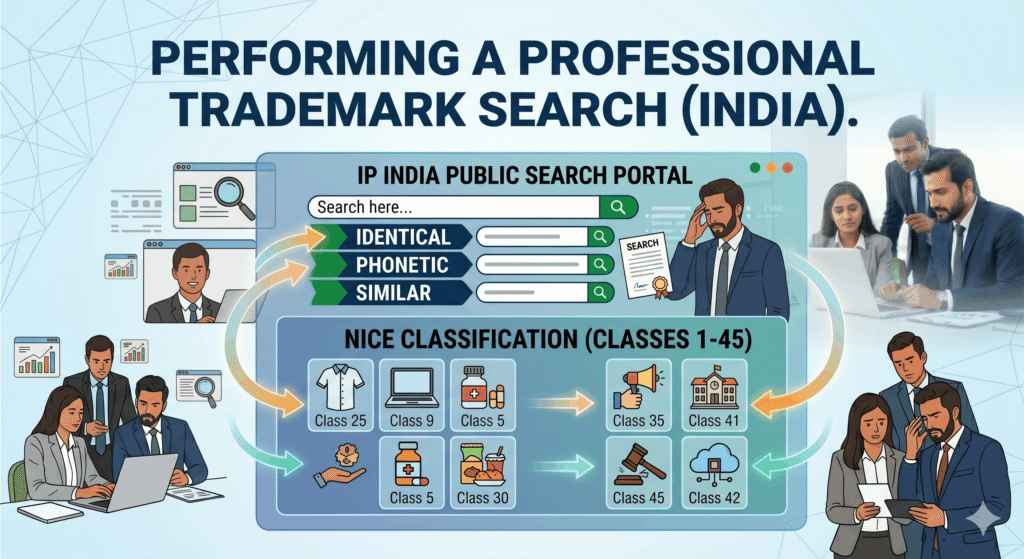
Running a thorough search before filing is not optional — it’s the single most important step that determines whether your application is likely to succeed or be objected to.
Where to Search
The IP India public search tool at ipindiaonline.gov.in lets you search the Register of Trade Marks. Run three types of searches:
- Word/phonetic search — search your brand name and variations that sound similar (sounds-alike names are treated as potentially confusing)
- Logo/device search — if you’re registering a logo, search by Vienna Classification codes for visual similarity
- Combined search — your name + logo as a combined mark
What you’re looking for: any registered or pending mark that is identical or “deceptively similar” to yours in the same or related class. A “deceptively similar” mark doesn’t have to be a letter-for-letter copy — if the overall impression is likely to confuse consumers, that’s enough for an objection.
If You Find a Conflict
A conflict doesn’t automatically mean you can’t file — it means your strategy needs to adapt. Options include:
- Choosing a sufficiently differentiated name or logo before filing
- Filing in different classes where no conflict exists
- Filing a coexistence application with proper legal argument if the marks are genuinely in different market segments
- Consulting a trademark attorney to assess the actual risk level
The cost of filing without searching: if the Registry raises a Section 11 objection based on an existing similar mark, you still pay for the class, still spend months on examination, and may ultimately face rejection — losing both time and government fees that are non-refundable.
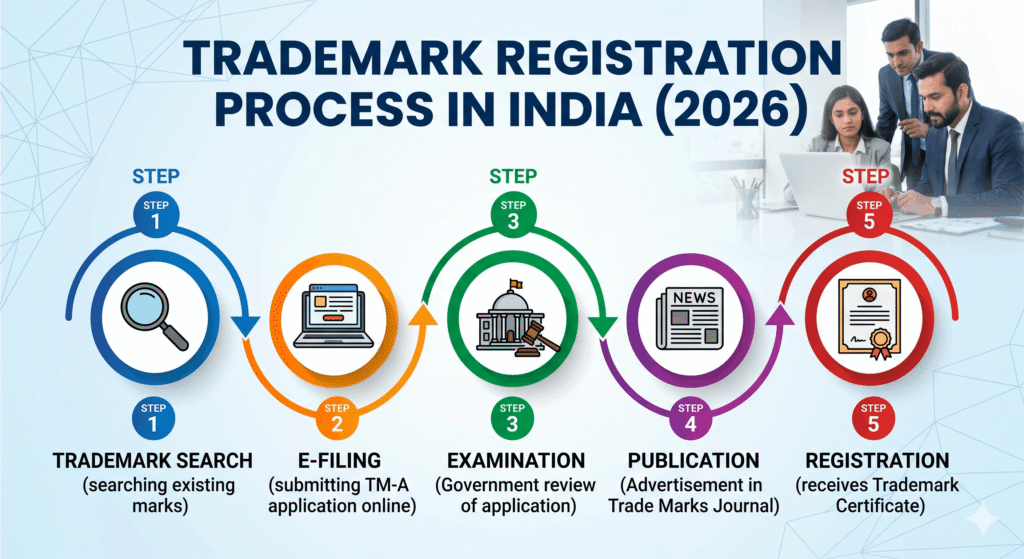
Step-by-Step: How to File Your Trademark Application
All filings in 2026 are done online through the IP India e-filing portal at ipindiaonline.gov.in. Filing is done via Form TM-A (the single form for all trademark applications).
Step 1: Create Your IP India Account
Register at ipindiaonline.gov.in. If you’re filing through a trademark attorney or agent, they will manage this under their credentials with a Power of Attorney (Form TM-48) authorizing them to file on your behalf.
Step 2: Complete Your Pre-Filing Search
Run the trademark search as described above. Confirm your mark is clear — or adjust if necessary — before spending fees on the actual application.
Step 3: Gather Your Documents
For most applicants, you’ll need:
| Document | Who Needs It |
|---|---|
| Identity proof (Aadhaar, PAN, or Passport) | All applicants |
| Address proof | All applicants |
| Trademark image in JPG format (min 8cm × 8cm, high resolution) | All applicants filing device/logo marks |
| Udyam Registration Certificate | MSMEs claiming 50% fee concession |
| DPIIT Startup India Certificate | Startups claiming 50% fee concession |
| Form TM-48 (Power of Attorney) | If filing through an agent |
| User affidavit (if claiming prior use before filing date) | Applicants with evidence of prior use |
| Partnership Deed / LLP Agreement / Certificate of Incorporation | Partnership, LLP, or Company applicants |
| Board Resolution authorizing the signatory | LLP and Company applicants |
Step 4: Fill Form TM-A Online
Log into the portal and fill in:
- Applicant details — name, address, entity type, contact information
- Trademark representation — upload your mark (word, logo, or both)
- Class(es) — select the Nice Classification class(es) you’re applying in
- Description of goods/services — this must precisely describe what you’re selling/providing within the chosen class
- Date of first use — if you’ve already been using the mark, specify when; if not yet in use, indicate “Proposed to be used”
- MSME/Startup certificate — attach your Udyam certificate here to claim the concessional fee
Step 5: Pay the Government Fee
Pay online via the portal. Payment is per class — the government fee is ₹4,500 per class for individuals, DPIIT-recognised startups, and Udyam-registered MSMEs; ₹9,000 per class for all other entities.
Step 6: Receive Your Application Number and Acknowledgement
The portal immediately generates an application number in the format XXXXXX/2026. This is your TM number. From this moment, you are authorised to use the ™ symbol alongside your brand name.
Download and save the acknowledgement — this confirms your priority date, which is the date from which your rights are calculated.
Step 7: Track Your Application Actively
Track your application status using the “Status of Your Mark” tool on the IP India portal by entering your TM number. Check it regularly — the registry sends no automatic email reminders. The Registry also sends no reminders for deadlines — you are solely responsible for monitoring your application and responding on time.
Step 8: Respond to Examination Report (If One is Issued)
After filing, your application enters the examination queue. The examiner reviews it within approximately 4 to 6 months in 2026, following a major recruitment drive for examiners in 2025 that is expected to bring this timeline down from the 8–10 months seen in 2022–2025.
Two outcomes are possible:
Accepted directly: the application moves straight to publication in the Trademark Journal. Proceed to Step 9.
Examination Report issued: the examiner has raised objections. Two categories of objections exist:
- Section 9 — Absolute Grounds: the mark itself has a problem (too descriptive, generic, or likely to deceive/cause confusion as to the nature of the goods)
- Section 11 — Relative Grounds: there is a similar or identical mark already on the Register in the same or related class
Critical deadline: you have 30 days from the date of the examination report to file a written response. Missing this window means the application is abandoned and you must refile from scratch with a later priority date.
Responding to an examination report requires a well-argued written submission explaining why your mark should be accepted despite the objections. If the examiner is not satisfied with your written response, a Show Cause Hearing is scheduled — and you (or your attorney) present arguments in person or virtually before the Registrar. No additional government fee is charged for responses or hearings.
Step 9: Publication and the 4-Month Opposition Window
Once the application clears examination (either directly or after a successful response), it is published in the Trademark Journal — a weekly digital publication accessible to the public.
The law mandates a fixed four-month opposition window from the publication date. During this period, any third party who believes your mark conflicts with their existing rights can file a formal opposition. This window is mandatory and cannot be shortened or extended regardless of whether expedited examination was used.
If no opposition is filed: the registration proceeds automatically at the end of the four months.
If an opposition is filed: a formal legal proceeding begins. Both parties submit evidence, file counter-statements, and may attend hearings before the Registrar. Opposition proceedings can add 12–24 months or more to the overall timeline. Professional legal representation is strongly advisable if your application is opposed.
Step 10: Registration Certificate
Once the opposition window closes without challenge (or opposition proceedings conclude in your favor), the Trademark Registration Certificate is issued. You can now legally use the ® symbol next to your brand name.
The registration is valid for 10 years from the date of filing, and renewable indefinitely in successive 10-year periods before expiry.
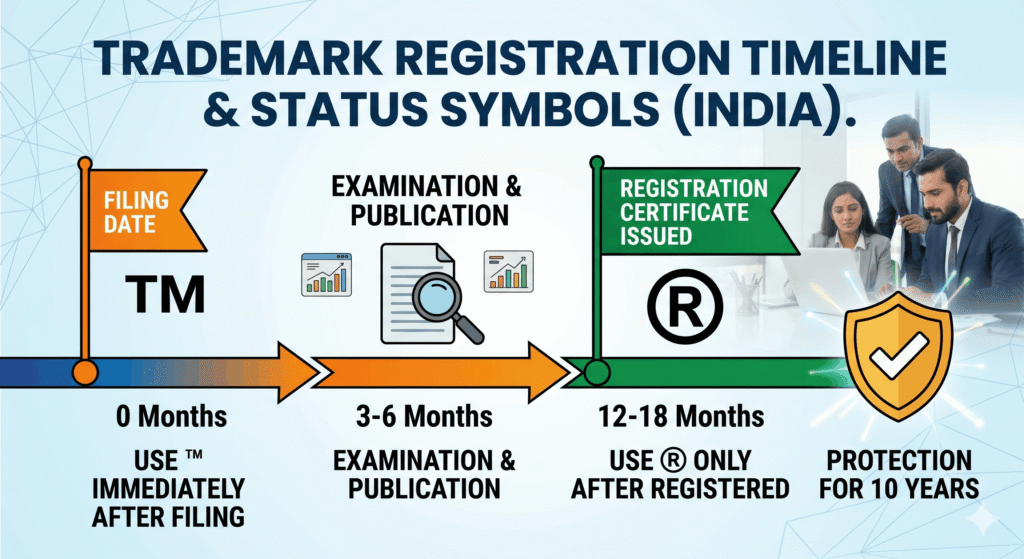
The Full Timeline at a Glance
| Stage | Typical Duration |
|---|---|
| Filing to acknowledgement | Instant (e-filing) |
| Formalities check | 1–2 weeks |
| Examination (2026, standard) | 1–3 months |
| Examination (expedited) | ~1 month |
| Response to examination report (if applicable) | Up to 30 days (applicant’s deadline) |
| Hearing and decision (if applicable) | 2–6 months |
| Publication in Trademark Journal | After acceptance |
| Opposition window | 4 months (mandatory) |
| Registration certificate issuance | 1–2 months after opposition window |
| Total (no objection, no opposition) | 8–12 months |
| Total (with objection/opposition) | 18–36 months or more |
The 5 Most Common and Costly Mistakes
1. Filing in the wrong class. Filing in the wrong class is a costly mistake as changes cannot be made after the application is submitted. You would have to file a fresh application and pay the fees again. Take the time to understand Nice Classification properly, or get professional help for this step.
2. Not running a thorough pre-filing search. Skipping the search to save time, only to receive a Section 11 objection months later, costs far more in time and professional fees than a careful search upfront.
3. Not providing the Udyam certificate when filing. If your enterprise qualifies as an MSME but files without providing the certificate, the Registry processes the application at the higher ₹9,000 rate. There is no retroactive adjustment. This is an avoidable cost — always attach your Udyam certificate.
4. Missing the 30-day examination report response deadline. The Registry sends no reminders. If you miss this window, your application is abandoned and your priority date is lost. Track your application status actively on the IP India portal.
5. Waiting too long to file. Many founders delay trademark filing until after they’ve launched — by which point a competitor may have already filed a similar mark. Your priority date is established from the moment you file, not from when you started using the mark. Filing early — even before your product is fully ready — secures your place in the queue.
What Happens After Registration: Protecting Your Mark
Registration is the beginning of protection, not the end of it. Active maintenance matters:
- Monitor for infringers. Periodically search the IP India database for new applications that might conflict with yours. Most trademark attorneys offer watching services that alert you to potentially conflicting filings.
- Renew before expiry. Your registration is valid for 10 years from the filing date. Renewal (Form TM-R) must be filed within the renewal window — missing it and seeking late renewal adds a surcharge; complete lapse requires a restoration application at ₹18,000 per class.
- Use it or risk losing it. A registered trademark can be challenged for “non-use” if you haven’t used it in connection with your goods/services for five or more years. Keep evidence of your actual commercial use of the mark.
- Take action against infringers early. Delays in enforcement can be used against you in court — a pattern of tolerating infringement weakens your position in future disputes.
Trademark vs Copyright — Not the Same Thing
A common confusion worth clearing up: trademark and copyright protect different things.
- Trademark protects brand identifiers (name, logo, tagline) that distinguish your goods/services — registered through the Trade Marks Registry
- Copyright protects original creative works (writing, photography, design art, music, software) — it arises automatically in India upon creation of the work, without registration
Your logo design may be simultaneously protected by both — trademark protecting it as a brand identifier, copyright protecting the artistic expression of the design itself.
Trademark registration is the foundational step in converting your brand identity — the name, logo, and visual system you’re building around your product — into a legally defensible asset. Done early, at the ₹4,500 MSME rate, it’s one of the most cost-effective legal protections available to a new Indian brand.
The correct sequence:
- Register for Udyam (free guide here) — this unlocks the 50% discount on trademark fees immediately
- Run a thorough trademark search on the IP India portal
- File Form TM-A online for your brand name and/or logo in the relevant class(es)
- Use ™ from the filing date, track your application status actively, respond to any examination report within 30 days
- After the 4-month opposition window closes without challenge, receive your ® registration certificate
File early — before launch if possible. Your priority date is established from the moment you file, not from the moment you start selling. The founders who regret not filing earlier invariably discover this only when someone else files a similar mark after their brand has already gotten traction.
Next step: Once your documentation foundation is complete (structure, GST, Udyam, trademark), the next stage is branding — creating the identity system that will go on your packaging, website, and marketplace listings. Read our guide: What Is a Brand Style Guide — and Why Your Business Needs One.
About This Article
This article is for general informational purposes and reflects the trademark registration framework in India under the Trade Marks Act, 1999 and Trade Marks Rules, 2017, as understood in 2026. Government fees, examination timelines, and procedures are subject to change by notification. Always verify current fee schedules on the official IP India portal (ipindiaonline.gov.in) and consult a registered trademark agent or trademark attorney for advice specific to your situation.